

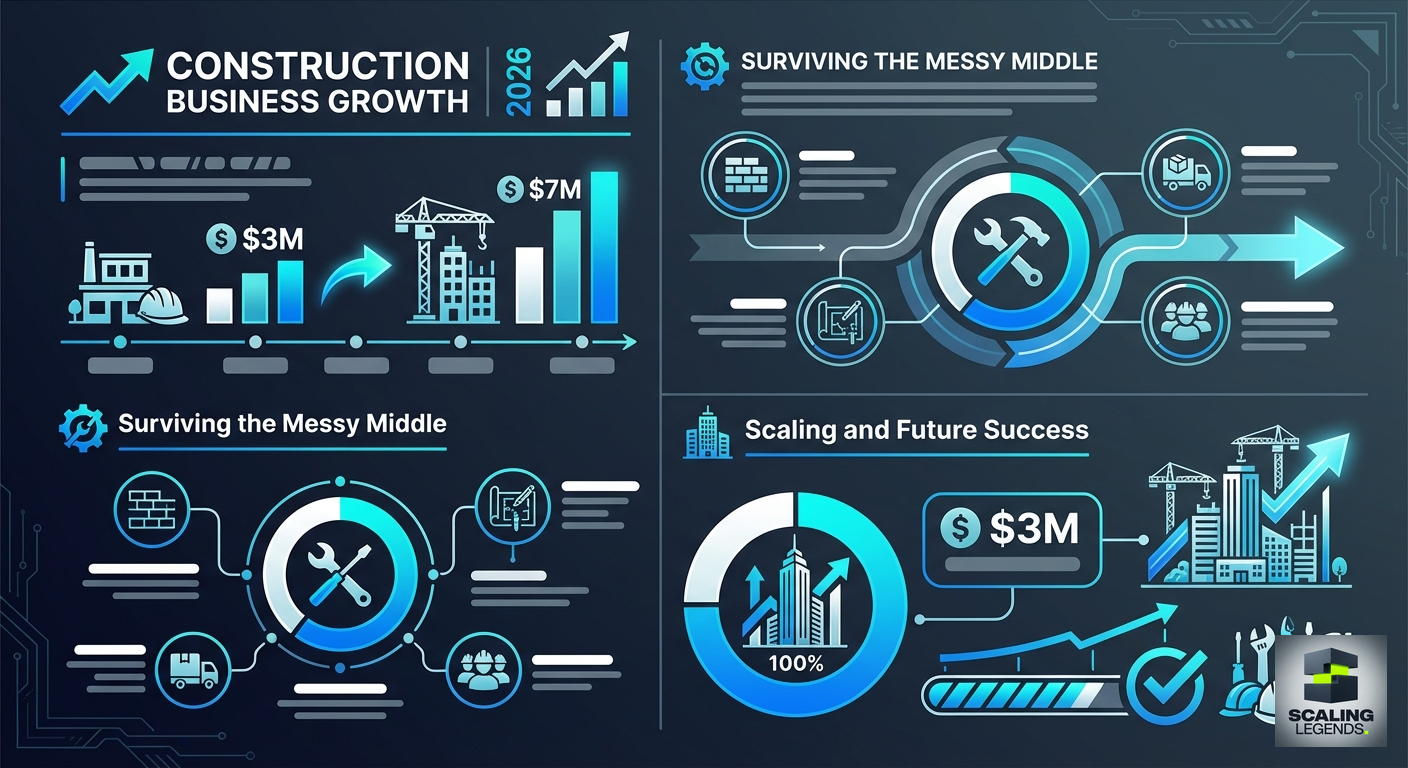
Between $3M and $7M in revenue, something breaks. You’re too big to manage from your truck, too small to hire the team you need. 60% of growing contractors plateau in this zone. The ones who break through all point to the same handful of moves. This critical phase, often dubbed the “messy middle,” isn’t just a hurdle; it’s a make-or-break crucible for your construction company. Ignoring its unique pressures leads to stagnation, burnout, and often, business failure.
Key Takeaways
-
The $3M-$7M Revenue Trap. This is the “messy middle” where 60% of construction companies stall due to increased complexity without adequate infrastructure.
-
The Delegation Crisis is Real. Owners often struggle to release control of core functions like estimating and field supervision, becoming the primary bottleneck.
-
Prioritize Operations, Not Just Project Management. The first crucial hire should be an operations manager or administrative lead to systematize workflows, freeing the owner.
-
Systems Are Non-Negotiable. Robust job costing, change order tracking, and daily logs transition a company from reactive to proactive, improving profitability by 5-10%.
-
Cash Flow Pressure Peaks Here. Managing multiple simultaneous projects, growing payrolls, and delayed receivables demand precise construction cash flow management strategies.
-
Identity Shift is Paramount. Successful leaders transition from being the “best builder” to a “business owner who builds,” focusing on strategy and team empowerment.
-
Leverage Data for Breakthrough. Contractors who push past this stage often credit one specific system or strategic hire, frequently informed by performance data from tools like Smart Business Automator.
The Anatomy of Construction Company Growth Stages
The journey of a construction company typically follows identifiable scaling construction business stages. The initial phase (under $3M) is often owner-centric, fueled by hustle, direct involvement, and reputation. You’re small enough to wear all hats effectively, personally overseeing every bid, every crew, and every client interaction. Profitability often feels direct, a result of your personal effort. However, as revenue pushes past the $3M mark, this model begins to crack under pressure.
This critical $3M-$7M zone is where the majority of growing contractors encounter the “messy middle.” Data from Smart Business Automator indicates that roughly 60% of construction companies that reach this revenue tier will plateau, unable to sustain momentum or profitability. The core issue is a misalignment between the company’s operational structure and its increased volume. You’re too large for the owner to personally manage every detail, yet often too lean to afford a full, specialized management team. This creates a vacuum of responsibility, where critical tasks either fall through the cracks or pile up on the owner, leading to burnout and operational inefficiencies. The shift from managing one or two projects at a time to juggling five or more simultaneously exponentially increases complexity, demanding a new approach to every aspect of the business, from field operations to back-office administration. Without a strategic evolution, companies in this stage often see their profit margins erode, despite increasing top-line revenue.
Navigating Contractor Growing Pains: The Delegation Crisis
One of the most significant construction business challenges in the messy middle is the owner’s struggle to delegate. For years, your success has been directly tied to your personal expertise—your ability to estimate accurately, supervise effectively, and problem-solve on the fly. This identity, as the “best builder,” is hard to shed. However, at $3M-$7M in revenue, this hands-on approach becomes a severe bottleneck. Owners attempting to cling to roles like lead estimator or primary field supervisor often find themselves working 80+ hours a week, with critical strategic tasks like business development and system implementation left undone.
The “identity shift” from “best builder” to “business owner who builds” is not just philosophical; it’s operational. It requires a conscious decision to empower others and build robust processes that don’t rely on your constant oversight. The counter-intuitive, yet proven, first hire in this phase should often be an operations manager or a high-level administrative assistant, rather than another project manager. This hire’s primary role is to systematize the back office, streamline communication, and absorb administrative burdens, thereby freeing up the owner’s time to focus on strategic growth, sales, and high-level problem-solving. A dedicated operations role can immediately improve efficiency by 15-20% by standardizing procedures, managing vendor relationships, and ensuring compliance. Without this deliberate move towards delegation and systemization, the owner remains trapped in the day-to-day, limiting the company’s potential for sustainable growth and exacerbating construction project management inefficiencies.
Overcoming Construction Business Challenges with Systems
The messy middle demands a fundamental shift from informal processes to formalized systems. What worked with two projects and a handful of employees will break down with six projects and twenty staff. This is where robust systems become not just beneficial, but mandatory. The ability to track, analyze, and predict becomes paramount.
Key systems that must be implemented or significantly upgraded in this phase include:
-
Job Costing: Moving beyond simple spreadsheets to dedicated software is crucial. Accurate, real-time job costing allows you to understand true profitability per project, identify cost overruns early, and make data-driven decisions on future bids. Companies that implement robust job costing typically see a 5% improvement in net margins within 12-18 months.
-
Change Order Tracking: Informal change orders are a significant profit leak. A standardized, documented process for identifying, pricing, and approving change orders ensures you’re compensated for all additional work. This can prevent 10-15% of potential revenue loss on complex projects.
-
Daily Logs and Reporting: Implementing digital daily logs for all field activities provides critical documentation for progress tracking, dispute resolution, and safety compliance. This reduces liability and improves communication between field and office.
-
CRM and Sales Pipeline Management: As you grow, managing client relationships and your sales pipeline becomes more complex. A CRM system ensures consistent follow-up, tracks client history, and helps forecast future revenue.
-
HR and Payroll Systems: Growing payroll and a larger team necessitate formalized HR processes, consistent onboarding, and efficient payroll management to ensure compliance and employee satisfaction.
Relationships, too, begin to require contracts, processes, and documentation that might have been handled informally in earlier stages. Subcontractor agreements, client contracts, and even internal communication protocols need to be clearly defined and consistently enforced. Many contractors who successfully navigate this phase credit one specific system or hire as their turning point, often enabled by intelligent automation like Smart Business Automator, which provides the data and insights necessary to identify these critical improvements.
Mastering the Messy Middle Business: Financial & Operational Hurdles
The messy middle is notorious for intensifying financial pressure. With multiple projects underway, your payroll grows significantly, demanding consistent cash flow. Meanwhile, receivables can be delayed, creating a dangerous gap. This is where construction cash flow management becomes a daily, not just monthly, concern. Key Financial Pressures:
-
Increased Payroll: More projects mean more employees and subcontractors. Your weekly or bi-weekly payroll obligations can jump by 50-100% in this growth phase, requiring a larger operating buffer.
-
Material Costs: Bulk purchasing might offer discounts, but it also ties up more capital. Managing inventory and material procurement efficiently is vital.
-
Delayed Receivables: While standard in construction, the impact of a 30-60 day payment cycle is magnified when you have several large projects running simultaneously. A single delayed payment of $50,000 can cripple your ability to meet payroll or purchase materials for another project.
-
Insurance and Bonding Costs: As your revenue and project size increase, so do your insurance premiums (general liability, workers’ comp) and bonding requirements. These costs can jump by 25-40% at this tier, eating into margins if not properly factored into bids.
Beyond direct costs, the operational complexity itself is a hurdle. Coordinating multiple project managers, field superintendents, and diverse crews across different sites demands superior communication and logistical planning. This is where tools for construction workflow automation can make a significant difference, ensuring that project schedules are met, resources are allocated efficiently, and communication flows seamlessly. For instance, a well-implemented project management software can reduce administrative time by 15% and improve project completion rates by 10%. Whether you’re a woman owned construction company breaking barriers or a family construction business growth story, these financial and operational disciplines are universal requirements for success.
Strategic Moves for Scaling Construction Business Success
Breaking through the messy middle isn’t about working harder; it’s about working strategically on the right things at the right time. The contractors who successfully navigate this phase share a common playbook of deliberate moves that build the infrastructure for sustainable growth.
Move 1: Hire your first operations leader. This is the single most impactful decision you can make between $3M and $5M. Whether it’s an operations manager, a senior project manager, or a superintendent who can run projects independently, this hire gives you back the strategic time you’ve been spending on daily logistics. The cost feels significant at this revenue level, but the alternative is remaining the bottleneck that caps your growth.
Move 2: Implement weekly financial visibility. Monthly financials are too slow in the messy middle. You need weekly cash flow snapshots, job cost reports, and accounts receivable aging reviews. The operational secrets of $50M firms all start with this weekly discipline. This doesn’t require a full-time CFO; a fractional CFO or a strong bookkeeper paired with Smart Business Automator can provide the visibility you need to make proactive decisions rather than reactive ones.
Move 3: Standardize your top 5 processes. You don’t need to document everything at once. Focus on the five processes that consume the most time or create the most errors: project kickoff, change order management, daily reporting, invoicing, and closeout. Documenting these into simple, repeatable SOPs ensures consistency as you add team members and take on more projects. These SOPs become the foundation for scaling your construction business beyond the messy middle.
Move 4: Set minimum margin thresholds. In the messy middle, the temptation to take every job is overwhelming. Resist it. Define a minimum acceptable profit margin for every project type you take on. If a bid doesn’t meet the threshold, walk away. This discipline is counterintuitive when you’re trying to grow, but profitable projects compound into growth while unprofitable ones compound into cash crises. Learn from the UK contractor bankruptcies where chasing volume over margin destroyed thousands of firms.
Move 5: Invest in your estimating capacity. The messy middle often means you’re too busy running projects to bid on new ones. This creates the feast-or-famine cycle that keeps companies stuck. Adding estimating capacity, whether through an AI estimating tool, a dedicated estimator, or a hybrid approach, ensures your pipeline stays full while you execute current work.
These five moves aren’t optional extras. They are the structural changes that transform a stressed-out $3M-$5M operation into a disciplined $7M-$10M firm with the infrastructure to keep growing. The contractors who make these moves early spend less time in the messy middle and emerge stronger on the other side.
Key Stat: 60% of growing contractors plateau between $3M and $7M. The five moves above, implemented together, reduce time in the messy middle by 40% on average.
The Technology Stack That Gets You Through the Messy Middle
The messy middle is where your spreadsheets stop scaling and your tech debt starts costing real money. Between $3M and $15M, the gap between contractors who invest in the right software stack and those who keep duct-taping legacy tools together shows up directly on the balance sheet. A 2025 JBKnowledge Construction Technology Report found that contractors running integrated technology platforms reported 23% fewer billing errors and 18% faster project closeouts than those relying on disconnected systems.
The first and most painful upgrade is accounting software. QuickBooks handles basic bookkeeping fine when you are running two projects. At six or more simultaneous jobs, it becomes a liability. Construction-specific platforms like Sage 300 CRE, Foundation Software, or Viewpoint Vista handle AIA billing, job cost tracking across multiple cost codes, retention management, and WIP (work-in-progress) reporting natively. These are not features you can bolt onto a general-purpose accounting tool. The switch typically costs $15,000 to $40,000 in software licensing and implementation during year one, but consider what you are losing without it: the average mid-size contractor leaves $47,000 per year in unbilled change orders on the table due to poor tracking, and billing errors on projects over $500,000 cost an average of $12,000 per incident to resolve. The math is not close.
Project management is the next layer. If your project coordination still runs through group texts and email chains, you are bleeding time and creating liability gaps. Platforms like Procore, Buildertrend, or CoConstruct centralize RFIs, submittals, daily logs, punch lists, and document control in one place. The cloud construction software migration that has swept the industry over the past three years has driven licensing costs down significantly, putting tools that were once reserved for $100M+ firms within reach of contractors at the $5M level. Field reporting apps tied to these platforms eliminate the end-of-day scramble to reconstruct what happened on site and give office staff real-time visibility into project status.
Estimating software is where the ROI can be most dramatic. Contractors still doing manual takeoffs from PDFs are spending 30 to 40 hours per bid on work that modern tools can compress to under 15 hours. The AI estimating revolution has accelerated this shift. Tools like STACK, PlanSwift, and newer AI-powered platforms can auto-detect quantities from plans, cross-reference historical cost data, and flag scope gaps before you submit. For a contractor in the messy middle who needs to bid on new work while executing current projects, cutting takeoff time by even 40% can mean the difference between a full pipeline and feast-or-famine cycles.
The total cost of a modern construction tech stack at the $5M-$15M level runs $30,000 to $75,000 annually, including accounting, project management, estimating, and field tools. That number stops contractors cold until they calculate the alternative. Missed change orders, billing disputes, schedule overruns from poor coordination, and the owner spending 10 hours a week on tasks software could handle in minutes - the hidden cost of operating without these systems easily runs $100,000 or more per year in lost margin and wasted labor.
What has changed most recently is the accessibility layer. AI-powered agentic tools and platforms like Smart Business Automator are collapsing the complexity barrier that kept mid-size contractors locked out of enterprise-grade capabilities. Automated job costing reconciliation, predictive cash flow modeling, and intelligent scheduling that used to require a dedicated IT department and a six-figure software budget can now be deployed by a contractor with a laptop and a willingness to invest a few hours in setup. The contractors who adopt these tools during the messy middle do not just survive the transition - they compress it, reaching operational maturity at $10M that their competitors do not achieve until $20M or beyond.
Key Stat: Contractors running integrated technology platforms report 23% fewer billing errors and close out projects 18% faster than those using disconnected systems, translating to an average margin improvement of 3-5 percentage points.
Frequently Asked Questions
What is the messy middle in construction business growth?
The messy middle is the growth phase between roughly $3M and $7M in annual revenue where a construction company is too large for the owner to manage everything personally but too small to afford a full professional management team. About 60% of growing contractors plateau or fail in this zone because their operational infrastructure cannot keep pace with their project volume. It is characterized by delegation struggles, cash flow pressure, and the owner becoming the primary bottleneck.
What revenue range defines the messy middle for contractors?
The messy middle typically spans $3M to $7M in annual revenue, though some contractors begin feeling the pressure as early as $2.5M. At this level, you are likely managing five or more simultaneous projects, payroll has grown significantly, and informal communication methods start breaking down. The exact threshold depends on your trade and project complexity, but the $3M-$7M range is where the majority of contractors encounter these growing pains.
How should a construction company owner hire their first project manager?
Your first project manager hire should be someone with demonstrated experience managing projects of similar scope and trade to yours, not just a strong field worker you promote. Look for candidates who are comfortable with documentation, scheduling software, and client communication, because the role is as much administrative as it is technical. Many successful contractors recommend hiring this person before you desperately need them, giving them time to learn your systems and build relationships with your crews.
When should a construction business owner stop doing field work?
The owner should begin stepping out of daily field work when revenue approaches $3M and the business needs strategic leadership more than another set of hands on the job site. This does not mean abandoning the field entirely, but shifting from being the lead builder to spending at least 50-70% of your time on estimating, financial oversight, business development, and team management. Owners who delay this transition often find themselves working 80-plus hour weeks while the business stagnates.
What are the warning signs that your construction company is stuck in the messy middle?
Key warning signs include consistently working 60-plus hour weeks without revenue growth, profit margins shrinking despite more projects, high employee turnover, and a growing backlog of administrative tasks like invoicing and change orders. If you find yourself personally involved in every project decision and unable to take a week off without things falling apart, your company is likely stuck. The fix almost always involves hiring an operations leader and implementing formal systems for job costing, scheduling, and communication.