

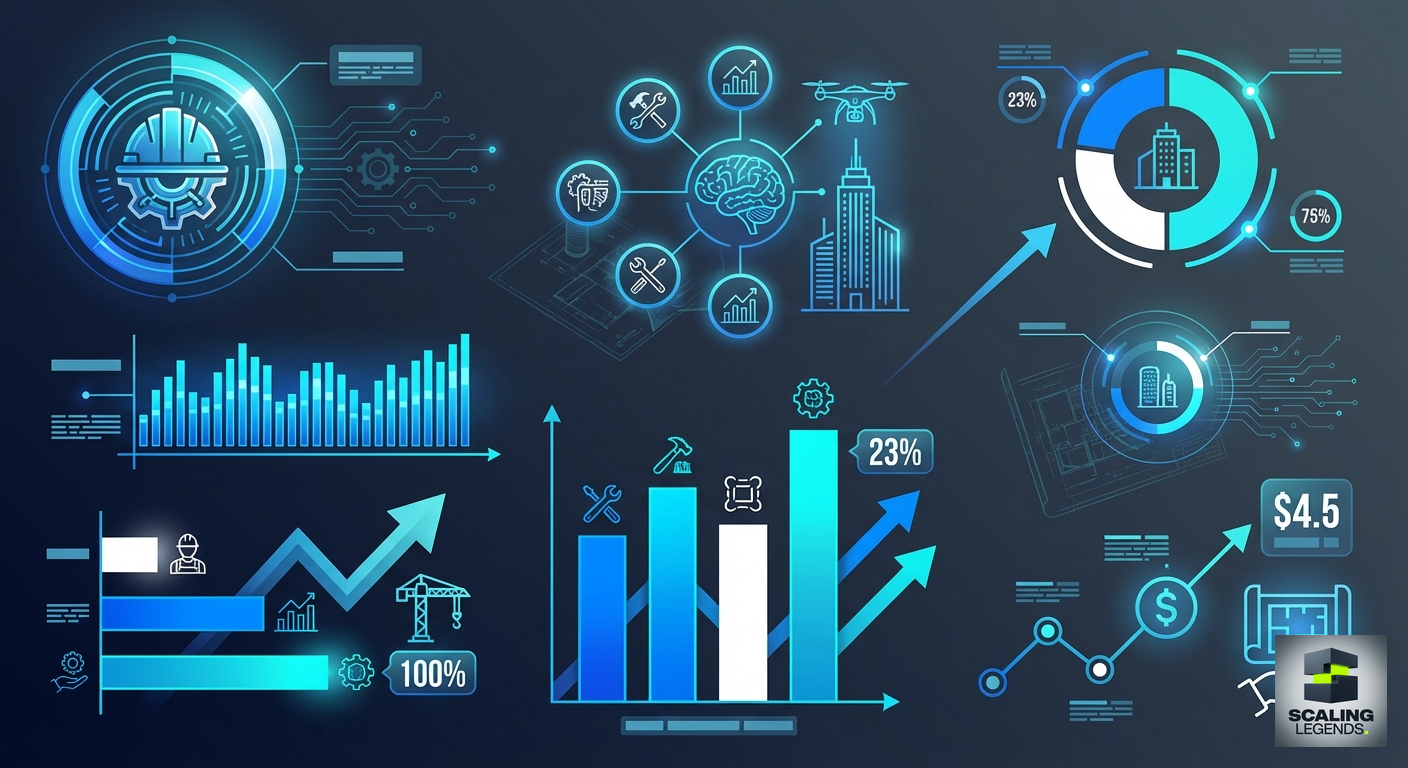
23% of contractors have adopted AI. The ones who have are cutting bid prep time by 75% and catching safety violations before OSHA does. The rest are still doing takeoffs by hand, losing competitive bids, and facing preventable delays. In a market where every margin point counts, waiting for the future means being left behind. Here’s what’s actually working on job sites right now, delivering tangible ROI and reshaping how successful contractors operate.
Key Takeaways
-
First-Mover Advantage is Real. Only 23% of contractors have adopted any AI tool, leaving a massive opportunity for early adopters to gain significant competitive edge.
-
Market Growth is Exploding. The global construction AI market is projected to hit $4.5 billion by 2027, up from $1.8 billion in 2024, indicating rapid maturation and widespread adoption.
-
Estimating is Revolutionized. AI-powered estimating reduces bid prep time by 60-75% for mid-size contractors, directly impacting win rates and operational efficiency.
-
Site Automation Delivers. Autonomous drone site inspections save 200+ field hours annually for GCs over $10M, while computer vision detects real-time PPE violations, enhancing safety.
-
Predictive Power Prevents Delays. AI-driven scheduling reduces project delays by an average of 15-20%, improving on-time delivery and client satisfaction.
-
Agentic AI is the Game Changer. The shift from AI that merely reports to AI that takes action, like autonomous project adjustments or optimized resource allocation, is transforming productivity.
-
Rapid ROI. Most contractors adopting AI are seeing a clear return on investment within 6-9 months, demonstrating immediate value.
The Agentic Shift: Why AI in Construction is Finally Working
For years, “AI” in construction felt like a buzzword, relegated to futuristic concepts or academic papers. Today, that narrative has fundamentally changed. The Smart Business Automator, a leading intelligence platform, confirms a critical shift: AI is no longer just generating reports; it’s becoming agentic. This means AI tools are now capable of taking proactive steps, making decisions, and executing tasks autonomously, moving beyond simple analytics to active problem-solving. This evolution is the core reason why scaling construction business owners are finally seeing tangible benefits and rapid ROI.
The market reflects this transformation, building on the construction software revolution that laid the digital foundation. The global AI in construction industry market is projected to surge from $1.8 billion in 2024 to an estimated $4.5 billion by 2027. This isn’t just incremental growth; it’s an acceleration driven by practical applications that directly address contractors’ most pressing challenges. From optimizing complex schedules to ensuring site safety, agentic AI solutions are proving their worth by integrating deeply into workflows and delivering measurable improvements.
Consider the difference: traditional AI might flag a potential schedule conflict. Agentic AI, however, will not only flag it but also propose alternative resource allocations, re-sequence tasks based on real-time data, and even communicate those changes to relevant stakeholders. This capability allows project managers to focus on high-level strategy rather than constant reactive adjustments. For contractors navigating the “messy middle” of growth, this level of autonomous assistance is invaluable, freeing up critical time and resources. The competitive landscape is shifting rapidly, and those who embrace this agentic shift are building a significant advantage.
Precision Bidding: The Power of AI Construction Estimating Software
One of the most immediate and impactful applications of AI in construction is within the estimating department. For mid-size contractors, AI construction estimating software is not just an enhancement; it’s a competitive necessity. Data shows that AI-powered estimating solutions are reducing bid preparation time by an astonishing 60-75%. This isn’t just about speed; it’s about accuracy, consistency, and the ability to bid on more projects with the same resources.
These advanced systems learn from every bid submitted, every project completed, and every market condition encountered. They analyze historical data on labor costs, material prices, subcontractor bids, and project outcomes to generate highly accurate estimates. This learning capability allows them to identify patterns and predict costs with a precision human estimators, no matter how experienced, simply cannot match consistently. The result is not only faster bids but also more realistic and profitable ones, improving your construction cash flow management by minimizing underbidding and maximizing successful project delivery.
The ROI for this technology is remarkably fast. Most contractors report seeing a payback within 6-9 months of implementing AI estimating software. This rapid return is due to several factors: increased bid volume, higher win rates, and reduced overhead associated with manual takeoff and calculation errors. Furthermore, the ability to rapidly generate multiple “what-if” scenarios allows contractors to optimize their bids for various risk profiles and profit targets, a strategic advantage in a tight market.
Key Stat: AI-powered construction estimating software reduces bid preparation time by 60-75%, leading to higher bid volumes and improved win rates for mid-size contractors.
This isn’t just about automating data entry. It’s about leveraging vast datasets to make smarter, data-driven decisions at the very beginning of the project lifecycle, setting the stage for profitable execution.
Beyond the Hype: Real-World Construction Automation on Site
The promise of construction automation is now being delivered on job sites, transforming operations from safety to scheduling. Agentic AI tools are providing real-time intelligence and proactive interventions that were previously impossible.
Autonomous drones, for instance, are revolutionizing site inspections. For General Contractors managing projects upwards of $10 million, these drones are saving over 200 field hours per year. Equipped with high-resolution cameras and AI processing, they conduct rapid, comprehensive inspections, identifying discrepancies between BIM models and actual progress, monitoring material stockpiles, and even detecting early signs of structural issues. Their ability to collect data consistently and tirelessly far surpasses manual methods, providing accurate, objective reports that feed directly into project management systems.
Equally impactful is the rise of computer vision for safety compliance. AI-powered cameras deployed on site are continuously monitoring for safety violations, such as missing Personal Protective Equipment (PPE) – hard hats, safety vests, gloves – in real time. These systems can instantly alert supervisors to non-compliance, allowing for immediate corrective action before an incident occurs. This proactive approach significantly reduces accident rates and helps contractors avoid costly fines from regulatory bodies like OSHA, creating a safer environment for all workers.
Safety First: Computer vision systems are detecting PPE violations and other safety hazards in real-time, drastically improving site safety compliance and reducing incident rates.
Furthermore, predictive scheduling AI is proving instrumental in keeping projects on track. By analyzing countless variables – weather forecasts, material delivery schedules, labor availability, and equipment breakdowns – these systems can predict potential delays with remarkable accuracy. They can then suggest adjustments to the project timeline, reallocate resources, or even automate critical path adjustments, reducing overall project delays by an average of 15-20%. This level of foresight transforms project management from reactive firefighting into proactive strategy. Instead of discovering a two-week delay after it has already happened, predictive scheduling flags the risk three weeks in advance, giving your team time to mitigate before it impacts the critical path. For contractors managing multiple simultaneous projects, this capability is transformative for maintaining schedule adherence and client satisfaction across the entire portfolio. Combined with workflow automation, these AI tools are creating a new standard of operational efficiency that will define competitive construction firms in the years ahead.
Key Stat: Predictive scheduling AI reduces overall project delays by 15-20% by analyzing weather, material deliveries, labor availability, and equipment status to flag risks before they impact the critical path.
The AI Construction Tool Landscape: What Contractors Are Actually Using
The gap between AI hype and AI adoption in construction comes down to one question: which tools actually deliver for a $3M to $50M contractor? The answer depends on which operational bottleneck is costing you the most money.
Here is how the major AI construction tool categories stack up in terms of real-world performance and adoption:
| Category | Top Tools | Time Savings | ROI Timeline | Adoption Rate |
|---|---|---|---|---|
| Estimating & Takeoff | Beam AI, Drawer AI, STACK | 60-75% faster | 6-9 months | ~15% of contractors |
| Schedule Optimization | ALICE, nPlan | 15-20% fewer delays | 9-12 months | ~8% of contractors |
| Safety & Compliance | Smartvid.io, Newmetrix | 40% fewer citations | 3-6 months | ~12% of contractors |
| Document Management | LLM-powered tools | 25-35% less admin | 2-4 months | ~10% of contractors |
| Fleet Management | Cat AI Assistant, Trackunit | 30-40% less downtime | 6-9 months | ~20% of contractors |
Estimating and Takeoff. This is where most contractors start because the ROI is fastest and most measurable. Beam AI and Drawer AI handle automated quantity takeoff from plans, reducing what used to be a 3-day process to under 4 hours. ProEst and STACK integrate AI-assisted estimating with historical bid databases, letting your estimates get smarter with every project. For contractors bidding on federal work under the IIJA, AI estimating is particularly valuable because Davis-Bacon wage calculations and Buy America material compliance add complexity that manual processes handle poorly at scale.
Schedule Optimization. ALICE Technologies remains the market leader for AI-powered schedule optimization, but nPlan has emerged as a serious competitor, trained on over 750,000 historical construction schedules. Both tools use machine learning to identify the fastest critical path through a project, but they work differently. ALICE generates thousands of schedule alternatives and ranks them by cost and duration. nPlan predicts the probability of hitting key milestones based on pattern matching against similar completed projects. For contractors managing 5-10 simultaneous projects, the portfolio-level visibility these tools provide is where the real value lives.
Safety and Compliance. Computer vision platforms like Smartvid.io and Newmetrix (now part of Oracle) process job site photos and video feeds to identify safety hazards automatically. These systems can detect missing PPE, unsafe scaffolding configurations, and housekeeping violations with accuracy rates exceeding 90%. They integrate with daily reporting workflows, meaning safety managers receive automated alerts rather than relying on manual walkthroughs that inevitably miss things. Given the OSHA 2026 crackdown and instance-by-instance citation policy, the cost of a single missed violation now justifies the annual license cost for most GCs over $5M.
Document Management and RFI Processing. Large language models are transforming how contractors handle the document avalanche. Tools built on GPT-4 and Claude can parse specifications, extract submittal requirements, draft RFI responses, and cross-reference contract clauses in seconds. Smart Business Automator reports that contractors using AI-assisted document processing are reducing administrative overhead by 25-35%, freeing project coordinators to focus on field coordination rather than paperwork.
Fleet and Equipment Management. Telematics platforms powered by AI, showcased at CONEXPO 2026, now predict equipment failures before they happen. The Cat AI Assistant manages mixed fleets across brands, tracking utilization rates and recommending when to rent versus own. For contractors spending $200K+ annually on equipment, predictive maintenance alone can reduce unplanned downtime by 30-40%.
The common thread across all these categories: the tools that work are the ones that integrate into existing workflows rather than demanding contractors rebuild their processes around new software. As AI adoption accelerates, construction cybersecurity becomes an equally critical concern. The best implementations layer AI on top of what teams already do, making existing processes faster and more accurate rather than replacing them entirely.
Implementation Strategy: How Mid-Size Contractors Adopt AI Without Breaking Operations
The biggest mistake contractors make with AI adoption isn’t choosing the wrong tool. It’s trying to implement everything at once. Data from construction technology consultancies consistently shows that contractors who adopt AI incrementally, one process at a time, see 3x higher sustained adoption rates than those who attempt company-wide rollouts.
Phase 1: Pick Your Highest-Pain Process (Months 1-3). Start with the single process that causes the most frustration or costs the most money. For most contractors in the $3M-$15M range, that’s estimating. For GCs over $15M managing multiple simultaneous projects, it’s usually scheduling or safety documentation. Don’t start with the process that’s “most interesting” or has the flashiest demo. Start with the one that, if improved, would most directly impact your bottom line.
Phase 2: Run a Parallel Test (Months 2-4). Run the AI tool alongside your existing process for 60-90 days. This dual-track approach serves two purposes: it validates the AI’s accuracy against your known baseline, and it gives your team time to build confidence in the output without the pressure of relying on it for live projects. Track specific metrics during this phase: time saved per estimate, accuracy variance, and user adoption rates among your team.
Phase 3: Integrate and Expand (Months 4-9). Once the first tool has proven its value, integrate it fully and begin evaluating a second process for AI augmentation. By this point, your team has developed an appetite for efficiency gains, making the second adoption significantly easier. The key is building internal champions: the estimator who now bids 3x more projects per month becomes the most persuasive advocate for AI adoption across the rest of the organization.
Budget Reality. For a contractor doing $5M-$15M in annual revenue, a realistic AI technology budget in 2026 runs $15,000-$40,000 per year across 2-3 tools. That’s the cost of one mid-level employee for about a month. When the average AI estimating platform saves 200+ hours of estimator time annually, the math is straightforward. The investment isn’t the barrier. The barrier is organizational change management, which is why the phased approach matters more than the tool selection.
The 77% Opportunity. With only 23% of contractors currently using any AI tool, the window for competitive advantage is still wide open. But it’s closing. As adoption accelerates toward the projected $4.5 billion market by 2027, the contractors who started in 2025-2026 will have 12-18 months of data training their AI systems, creating a compounding advantage that latecomers cannot simply purchase. The gap between AI-enabled contractors and traditional operators will widen on every measurable dimension: bid volume, win rates, schedule adherence, safety records, and ultimately, margins. The question isn’t whether to adopt. It’s whether you can afford to be in the 77% that hasn’t.
Frequently Asked Questions
What is agentic AI in construction and how is it different from regular AI?
Agentic AI goes beyond generating reports or flagging issues. It autonomously takes action, such as re-sequencing tasks, reallocating resources, and communicating schedule changes to stakeholders without waiting for human intervention. Traditional AI in construction is passive and analytical, while agentic AI actively solves problems and executes decisions in real time.
What are the best AI tools for contractors in 2026?
The leading AI tools for contractors in 2026 include Beam AI and Drawer AI for estimating, ALICE Technologies for schedule optimization, Buildots for delay forecasting, and nPlan for predictive scheduling trained on 750,000 historical construction schedules. The best tool depends on your trade, company size, and which operational bottleneck you need to address first.
How does AI reduce construction project delays?
AI-driven scheduling tools analyze weather forecasts, material delivery timelines, labor availability, and equipment status to predict potential delays before they happen. These systems then automatically suggest or implement timeline adjustments and resource reallocations, reducing overall project delays by an average of 15-20% for contractors who adopt them.
Is AI safe for construction site management and safety compliance?
AI-powered computer vision systems are proving highly effective for construction site safety. These cameras continuously monitor for PPE violations, unsafe behaviors, and hazardous conditions in real time, alerting supervisors instantly so corrective action can be taken before incidents occur. The technology augments human safety oversight rather than replacing it.
What is the ROI of AI adoption in construction?
Most contractors adopting AI tools see a clear return on investment within 6 to 9 months. AI-powered estimating alone reduces bid prep time by 60-75%, enabling contractors to bid on significantly more projects. The global construction AI market is projected to grow from $1.8 billion in 2024 to $4.5 billion by 2027, reflecting the proven financial returns driving rapid adoption.