

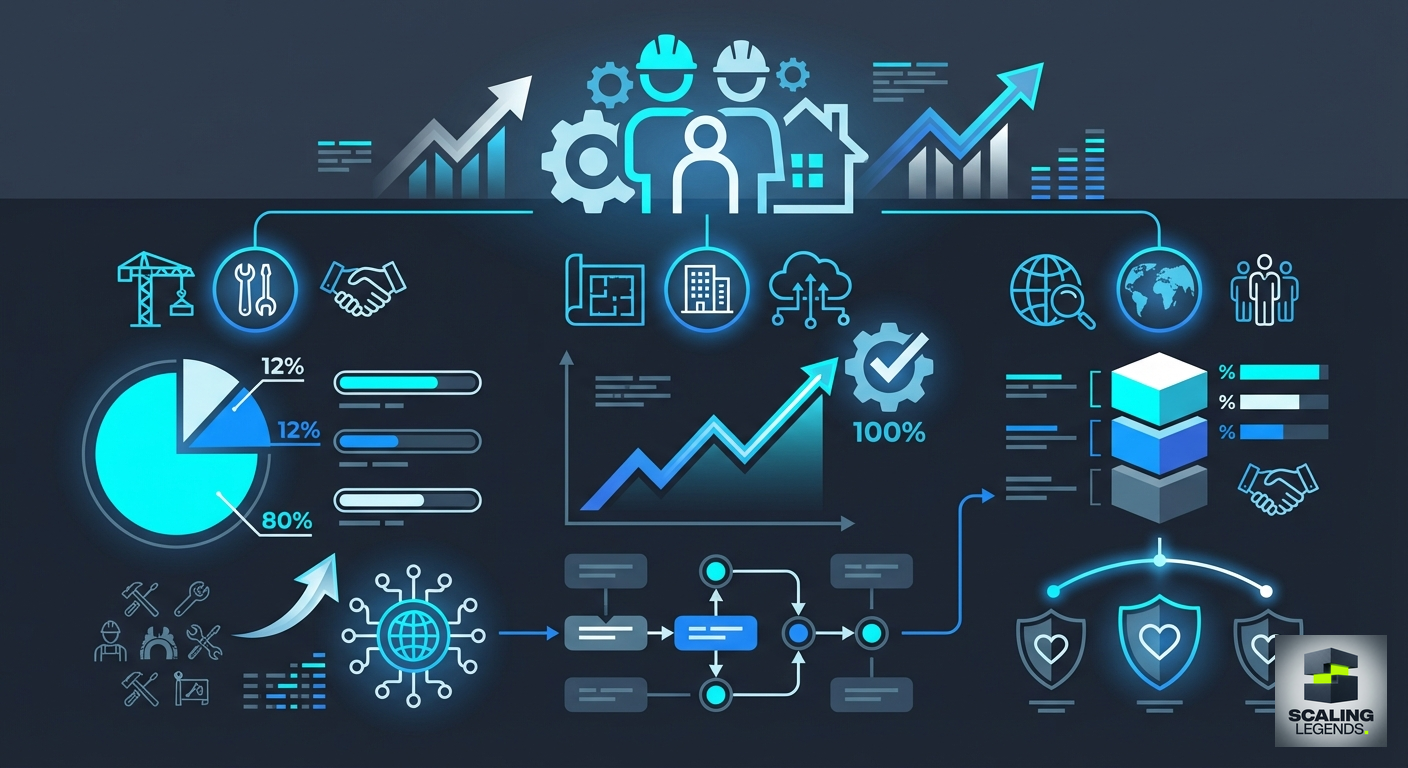
Over 80% of construction companies in America are family-owned. Yet, a stark reality looms: only 12% survive to the third generation. This isn’t just a statistic; it’s a testament to the unique, often painful, challenges of blending bloodlines with bottom lines. The family construction businesses that break this cycle don’t just build structures; they figure out how to professionalize operations and scale effectively without destroying the very culture that made them special in the first place. This transition demands strategic foresight, operational discipline, and a deep commitment to evolving while preserving your core identity.
Key Takeaways
-
Separate Family from Business. The inability to differentiate family dynamics from critical business decisions is the number one killer of family firms. Implement clear governance structures early.
-
Define Roles and Responsibilities. Avoid the “everyone does everything” trap by establishing explicit job descriptions, reporting lines, and performance metrics for all employees, family or not.
-
Professionalize Management. Embrace standardized processes, modern technology, and data-driven insights. This doesn’t mean losing your personal touch; it means delivering it more efficiently and consistently.
-
Prioritize Succession Planning. Begin the succession process 5-10 years before any transition. Document institutional knowledge systematically to prevent critical information from walking out the door.
-
Build an External Advisory Board. Gain invaluable objective perspectives and reduce family blind spots by bringing in experienced, non-family advisors.
-
Cultivate an Inclusive Culture. Attract and retain top non-family talent by fostering a merit-based environment where professional growth and contribution are valued above all else.
-
Formalize Core Values. Documenting and living your company’s core values significantly boosts employee retention, with family companies seeing up to 35% higher retention rates.
Separating Family Dynamics from Business Decisions: The Core Challenge for a Family Construction Business
The foundation of a successful, scaling family construction business rests on its ability to draw a clear line between the dinner table and the boardroom. With over 80% of all construction companies in the US being family-owned, this distinction is often blurred, leading to the number one killer of these firms: the inability to separate family dynamics from business decisions. When personal relationships dictate operational choices, the business inevitably suffers from inefficiency, favoritism, and internal conflict.
Consider a scenario where a less-qualified family member is promoted over a highly competent, non-family employee simply due to their last name. This not only demoralizes the non-family talent, making it incredibly difficult to attract and retain skilled professionals, but also sends a clear message that merit takes a backseat to kinship. Over time, this erodes morale, productivity, and ultimately, profitability.
To counter this, establishing clear roles and responsibilities is paramount. Every position, from the CEO down to project managers and field crews, must have a defined job description, measurable performance indicators, and a clear reporting structure. This prevents the “everyone does everything” trap, where overlapping duties lead to confusion, accountability gaps, and duplicated efforts. For a scaling construction business, this structure is non-negotiable.
Implementing a robust organizational chart, complete with defined lines of authority, helps professionalize the internal environment. This doesn’t mean stripping the business of its family feel, but rather ensuring that business decisions are made objectively, based on data and strategic goals, rather than emotional ties or family hierarchy. For instance, using data from platforms like Smart Business Automator can provide objective metrics to evaluate performance, project profitability, and operational efficiency, removing subjective biases from critical decisions. This shift allows the business to grow based on its capabilities and market opportunities, rather than being constrained by internal family politics.
Key Stat: Over 80% of construction companies in the US are family-owned, yet the inability to separate family dynamics from business decisions is cited as the primary reason for their failure to scale or survive across generations.
Professionalizing Operations Without Losing Your Construction Business Culture
The fear of “losing the soul” of the company is a legitimate concern for many family-owned contractors embarking on a journey of professionalization. However, adopting professional management practices doesn’t necessitate sacrificing the personal touch, strong work ethic, or deep client relationships that define a positive construction business culture. Instead, it’s about embedding these values into scalable systems.
Professionalization means standardizing processes, implementing robust project management frameworks, and leveraging technology to enhance efficiency and consistency. For example, moving from ad-hoc planning to structured construction project management protocols ensures projects are delivered on time and within budget, regardless of who is managing them. This reliability, in turn, strengthens client trust and reinforces the company’s reputation for quality.
The key is to formalize the values that make your family business unique. If your company prides itself on exceptional client service, document the specific steps and standards that define this service. Train all employees, family and non-family alike, on these standards. This ensures that as your company grows, the client experience remains consistently excellent. Data shows that family companies that formalize their values see 35% higher employee retention. This isn’t just about keeping employees; it’s about retaining the institutional knowledge and the cultural torchbearers who embody your company’s ethos.
Attracting and retaining non-family talent is critical for scaling. No family business can grow significantly without bringing in external expertise and diverse perspectives. A professionalized environment, where meritocracy is evident, career paths are clear, and compensation is competitive, is far more appealing to top talent. Non-family employees want to know they have opportunities for growth and that their contributions are valued, not just tolerated. Creating an equitable workplace where performance is objectively measured and rewarded is essential. This allows the company to tap into a wider talent pool, bringing in specialized skills in areas like finance, marketing, or advanced construction technologies that may not exist within the family unit.
Key Stat: Family companies that formalize and clearly communicate their core values experience 35% higher employee retention rates, demonstrating the power of cultural clarity in a scaling environment.
Charting the Future: Effective Succession Planning for Your Family Owned Contractor
The “3-generation curse,” where only 12% of family businesses survive to the third generation, underscores the critical importance of effective succession planning for any family owned contractor aiming for long-term viability. Many family businesses fail not because of market forces, but due to internal strife, lack of preparation, or an unwillingness to address the inevitable transition of leadership.
Succession planning is not a last-minute scramble; it’s a strategic process that should ideally begin 5-10 years before any anticipated transition. This extended timeline allows for several crucial steps:
-
Identification of Successors: Determine potential successors, both family and non-family, who possess the necessary skills, experience, and leadership qualities.
-
Training and Development: Provide comprehensive training, mentorship, and opportunities for these individuals to gain experience in various facets of the business. This might include external executive education, shadowing current leaders, or leading specific projects.
-
Mentorship and Skill Transfer: Actively transfer institutional knowledge from current leaders to their successors. This is especially vital in construction, where deep practical experience and relationships are invaluable. Documenting key processes, client histories, and supplier relationships before they walk out the door with retiring family members is non-negotiable.
-
Phased Transition: Implement a gradual handover of responsibilities, allowing the new leader to acclimate and the outgoing leader to provide guidance and support.
A significant challenge often faced by a woman owned construction company, or any family business, is overcoming internal resistance to change and ensuring that the most qualified individual, regardless of gender or family status, assumes leadership. This requires objective evaluation and a commitment to the business’s long-term health over personal preferences.
Creating an advisory board with outside perspectives is another powerful tool to reduce family blind spots. These boards, comprised of experienced professionals from outside the family, can offer objective advice on strategic decisions, leadership development, and succession planning. They provide a neutral ground for discussing sensitive issues and ensure that the business’s best interests remain the priority. This external validation can also help mitigate internal family conflicts by providing an impartial viewpoint on difficult decisions. For example, an advisory board can help structure the transition plan, evaluate successor candidates, and ensure the process is transparent and fair.
Key Stat: Only 12% of family businesses survive to the third generation, primarily due to inadequate succession planning and the inability to separate family dynamics from strategic leadership transitions.
Driving Construction Company Growth Through Strategic Financial & Workflow Management
Achieving significant construction company growth requires more than just winning bids; it demands robust financial oversight and optimized operational workflows. Many growing contractors encounter cash flow issues not because they lack work, but because they lack the systems to manage it effectively.
Strategic financial management is the backbone of scaling. This includes meticulous budgeting, accurate job costing, and proactive construction cash flow management. As project sizes and volumes increase, the margin for error shrinks. A small miscalculation on a single large project can have a devastating impact on the entire company’s liquidity. Implementing financial controls, regular forecasting, and scenario planning are essential. Leveraging financial analytics tools can provide real-time insights into project profitability, overhead costs, and working capital needs, allowing for agile decision-making.
Alongside financial discipline, optimizing operational workflows is critical. The “everyone does everything” mentality, common in smaller family businesses, becomes a bottleneck as the company scales. Standardizing processes for everything from bidding and procurement to project execution and closeout ensures consistency, reduces errors, and improves efficiency. For instance, implementing construction workflow automation for tasks like material orders, RFI submissions, or daily reporting can save countless hours, allowing skilled personnel to focus on higher-value activities.
Consider the impact of a streamlined bidding process. By automating data entry, using templates, and integrating with cost estimation software, a company can increase its bid volume and accuracy without proportionally increasing administrative staff. This operational efficiency directly contributes to the bottom line, freeing up capital and resources for further investment in growth initiatives, new equipment, or talent development. Utilizing an integrated platform like Smart Business Automator can provide the intelligence needed to identify bottlenecks, optimize resource allocation, and ensure that every project contributes positively to your growth trajectory. This data-driven approach allows for continuous improvement and sustainable expansion.
Key Stat: Companies that implement robust workflow automation can reduce administrative time by up to 30%, directly impacting project efficiency and overall profitability.
Frequently Asked Questions
How do you define clear roles in a family construction business without causing conflict?
Defining clear roles in a family construction business requires a structured, objective approach. Start by conducting a thorough organizational analysis to identify all necessary positions and their core functions. Then, create detailed job descriptions for each role, outlining responsibilities, required skills, and reporting lines — treat family members as you would any other employee. Use an external facilitator or an advisory board to help mediate discussions and ensure objectivity when assigning roles. Emphasize that roles are based on qualification and contribution, not solely on family status.
How do you keep family culture intact while scaling a construction company?
The key is to formally document the core values and cultural traits that define your family business before you begin scaling. When these values are codified into hiring practices, onboarding, and daily operations, they persist even as the team grows beyond the founding family. Companies that formalize their culture see up to 35% higher employee retention because both family and non-family members share a clear sense of identity.
When should a family construction business start succession planning?
Succession planning should begin 5 to 10 years before any anticipated leadership transition. This gives the next generation time to gain experience across all business functions, build credibility with employees and clients, and develop the leadership skills needed to run the company. Waiting until retirement is imminent creates rushed decisions that often lead to internal conflict or loss of key institutional knowledge.
When is it time to bring in non-family management to a family construction business?
The clearest signal is when growth demands specialized skills that no family member possesses, such as financial management, HR, or business development at scale. Bringing in non-family executives becomes essential when the company crosses the $5M-$7M revenue threshold and needs professional operational leadership. The hire works best when the family establishes merit-based evaluation criteria and gives the outside manager genuine authority within their role.
What are the pros and cons of a family structure versus a corporate structure for a construction company?
Family-structured construction businesses benefit from faster decision-making, stronger loyalty among long-tenured employees, and a deeply personal brand that clients trust. The downsides include the risk of nepotism, difficulty attracting outside talent, and emotional conflicts bleeding into business decisions. Many successful family contractors adopt a hybrid approach, maintaining family ownership and values while implementing corporate governance practices like advisory boards and formal performance reviews.